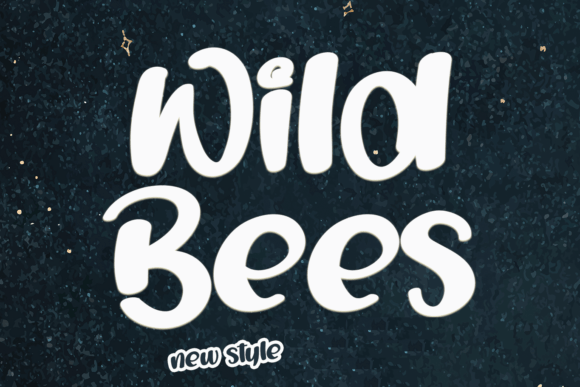
Wild Bees Display Font for Handmade Creators
If you’ve ever held a hand-stamped greeting card, admired a boutique candle label with delicate charm, or designed a wedding welcome sign that made guests pause and smile—you know how much a single font can shape the feeling of your work. Wild Bees is one of those rare display fonts that feels both intentional and effortless: soft curves, gentle contrast, and a quiet romanticism that never leans into cliché. It’s not overly ornate, but it’s never plain—it carries warmth like honey in sunlight, and that makes it deeply effective for physical products and digital printables alike.
Why Wild Bees Works So Well on Real Products
This isn’t just another script font you’ll use once and forget. Wild Bees was built for visibility and emotional resonance at real-world sizes—whether it’s laser-cut onto birch wood tags, printed crisp on kraft sticker sheets, or heat-pressed onto linen tote bags. Its letterforms have generous spacing and open counters, so even at 18–24pt on a small product label (like for bath salts or herbal tea blends), it stays legible without sacrificing personality. On larger applications—farmhouse-style wall art, wedding signage, or framed printable quotes—it blooms beautifully, especially when paired with subtle texture overlays or muted watercolor backgrounds.
Where I Reach for Wild Bees First
- Candle & Apothecary Labels: “Lavender Honey” or “Wild Rosemary” in Wild Bees feels artisanal—not generic. I pair it with a clean sans serif (like Montserrat or Inter) for ingredients and weight details, keeping the brand voice cohesive and trustworthy.
- Wedding Invitations & Day-of Stationery: It shines as a name font or headline—think “Emma & James” on an ivory vellum insert, or “Welcome to Our Garden” on a chalkboard-style welcome sign. Its gentle rhythm supports elegance without stiffness.
- Seasonal Printables: For Valentine’s Day planner pages or spring-themed SVG bundles, Wild Bees adds tenderness without looking dated. I’ve used it for “You’re My Favorite Person” stickers and “Bloom Where You’re Planted” wall art—both sold consistently across Etsy and my own shop.
- Product Packaging & Tags: On cotton garment tags, ceramic mug decals, or handmade soap wraps, it conveys care and craftsmanship. Customers notice—and they remember how something *felt* when they first saw it.
Readability Tips That Actually Matter
Let’s be practical: if your cutting machine struggles with thin connections or overlapping swashes, your stickers won’t cut cleanly—and your time (and material) is lost. Wild Bees includes well-designed alternates and optional ligatures, but I recommend using the standard character set for anything under 30pt. For Cricut Design Space or Silhouette Studio, I always convert text to outlines before sending to cut—especially for curved phrases or arched banners. And for printed cards? Test print a 2-inch sample first: check spacing between letters like “A” and “V”, and watch how lowercase “e” and “a” hold up at 14pt. This font rewards attention to detail—and pays off in perceived quality.
Smart Pairings That Elevate Your Designs
Wild Bees sings brightest when balanced. As a display font, it’s not meant for body copy—but it plays exceptionally well with others. My go-to pairings:
- A light or regular-weight sans serif (like Manrope or Open Sans) for supporting text—perfect for ingredient lists, event timelines, or care instructions.
- A low-contrast serif (like Playfair Display or Lora) for layered elegance—ideal for bridal collections or luxury packaging where you want quiet sophistication.
- A minimal handwritten font (not overly bouncy or tight) for handwritten-style accents—like “hand-poured” or “made with love” beneath a Wild Bees headline.
Avoid pairing it with heavy geometric sans serifs or ultra-thin scripts—they compete instead of complement. Let Wild Bees breathe, and let its gentle confidence carry the emotion.
Licensing, Files, and What You’ll Actually Use
When you license Wild Bees, you’re getting more than just a .ttf file. It includes OpenType features like stylistic alternates and standard ligatures—great for avoiding awkward letter collisions in words like “flow” or “love”. The font ships in both OTF and TTF formats, so it works seamlessly in Canva, Adobe Creative Cloud, Cricut Access, and Silhouette Studio. While it doesn’t include extended Latin or Cyrillic support, it covers full Western European languages—enough for most U.S., Canadian, UK, and Australian sellers.
Most importantly: yes, it’s cleared for commercial use. That means you can use Wild Bees in client projects, sell physical goods with it printed or cut (invitations, mugs, apparel), bundle it into digital templates (planner kits, Canva templates, SVG bundles), and include it in editable design files—as long as you’re not reselling the font file itself. Always double-check the license terms before launching a high-volume product line, but for crafters building real businesses? This is a safe, versatile, and expressive choice.
Final Notes From One Maker to Another
Fonts are tools—but Wild Bees feels like a collaborator. It helps me say “this matters” without saying a word. Whether it’s the curve of the lowercase “g”, the soft entry stroke on “h”, or the way “&” nestles naturally between names—it brings intentionality to every project. It doesn’t shout. It invites. And in a crowded marketplace where handmade buyers choose based on feeling first and function second, that quiet magic is worth its weight in gold.